Finally starting to pack for the Left Coast trip. Hope the plane gets out in the 50 MPH winds tomorrow.
Tuesday, February 10, 2009

Monday, February 02, 2009
Monday, January 26, 2009
Wednesday, December 31, 2008
Monday, December 15, 2008
Friday, December 12, 2008
Tuesday, December 02, 2008
Friday, November 21, 2008
Thursday, November 13, 2008
Tuesday, October 28, 2008
Tuesday, October 14, 2008
Monday, October 13, 2008
Sunday, October 12, 2008
Thursday, October 09, 2008
Wednesday, October 08, 2008
Tuesday, October 07, 2008
Monday, October 06, 2008
Saturday, November 04, 2006
Thailand Bails on OLPC (now known simply as "XO")
Well, apparently the new military-led government in Thailand has a thing about cheap computers. Or, at least it would seem that way. The Thai government, according to sources there, has backed out of a deal to buy a million of the OLPC Project's lappies. The information minister has derided the project as a "toy," and they've called off the whole deal.
This as the first 50 real, live units ship out to Brazil for testing in the wild. Way to kill the buzz, Thailand! Sheesh!
And lest we go two months without another alphabet-soup moniker to throw around, Negroponte's gang has rechristened their machine the XO. It's all, like, totally huggy-kissy and all, but like, c'mon, dudes ... we were just getting used to calling it "2B1," and now you go and change and we have to get all new keywords and labels and search engine tags and whatnot.
Classmate PC Gets (Almost) Real
Those of you scoring at home can add a tally mark to the until-now-empty Intel column on the scorecard of low-cost, third-world-loving computers. The Classmate PC, which can be had for the price of three units from that other organization, has finally got some specs.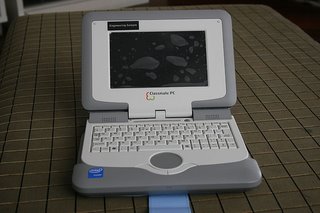
Firstly, lest we think the developing world will be completely Micro$uck-free in the oh-so-connected future, the Classmate will be sporting everybody's FAVE OS, Windows XP. (There's a third of the $400 price tag, right there!)
To power that resource-loving XP, the Classmate will carry a whopping 256MB DDR2 RAM (can you even boot XP past a Blue Screen Of Death with that?), a single lonely GB of NAND flash storage, a 7" display at 800x400, and a 6-cell lithium-ion battery (Sony? Wait, do we smell smoke??). Oddly, the Classmate d33t5 FROM INTEL fail to mention a processor. What up with that?
Anyway, you can get your Classmate on in the Spring of 2007, allegedly. For those developing nations who will eschew the open-source OLPC, the Classmate will be the, uh, not exactly "Cadillac," but probably a (small) step up from the hand-crank love. Cool, huh?
Photo credit: Ricardo's Blog, at (oddly enough) www.ricardosblog.com.
Sunday, October 22, 2006
Education Tools for iPod
A company called Talking Panda has come up with what appears to be a neat little Mac application (sorry, Windows users!) that lets you build "study tools" that can be replayed on an iPod. Details are a bit sketchy, but from the product writeup it appears that teachers would use iWriter to create combinations of text, audio, and even video that is specifically formatted for replay on the iPod display. For students without the indispensible and ubiquitous little wonder, the files can also be uploaded to .Mac or to a teacher's website for use on a 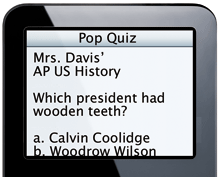
Templates provided include syllabi for college and high school, lecture notes, multimedia presentation, "ESL Listen and Learn," and "radio show." As you create your project, you can click a button to see how it will appear on an iPod, making sure your ideas translate to the small screen. You can attach audio to your lecture notes, so you can "illustrate" your lecture notes rather than just provide an audio version of your lecture. You can also link to the audio of the lecture, though, so you can provide both. But hey, why not have both?? iWriter lets you build multi-page projects, similar to building a multi-page website, and then you can upload to .Mac, or even use the final project as a website of sorts, by posting the pages to your class site.
Talking Panda doesn't disclose pricing or let you download a demo without providing an e-mail address (shame on them!) but at least they promise not to sell your d33ts to someone else. The software is only $30, but you can try it free for 15 days. Cool, huh?
Saturday, October 21, 2006
Univ. of Arizona and IBM to Unleash Web 2.0
Web 2.0 is coming to the classroom at Arizona University, and, eventually, to Global 1,000 businesses. The new program, for MIS and Marketing students, is designed to attract and train students in Web 2.0 technologies, and how they can be applied to business in the 21st century.
Wikis, blogs, social networking, tagging, and other popular technologies are destined not just to impact businesses, but to attract students to an MIS program with dwindling enrollment. By one estimate, enrollment in computer science programs is down a whopping 32% nationwide over the last four years. AU and Big Blue intend to reverse the trend, in part by offering a curriculum steeped in technologies the kiddies are already using online. The logic goes something like this: "the kids dig this stuff on their favorite sties; let's teach 'em how to build it and put some butts in the seats."
Of course, the ultimate effect on modern business remains to be seen. While companies such as YouTube (now GooTube), MySpace, and Digg show explosive growth in traffic, they have yet to establish clear monetization models. Perhaps the Econ department at AU should look at this program as well, offering tips not just in how to build Web 2.0 tools, but how to leverage them and make money.
The program at AU will probably be one of many efforts to build MIS enrollment across the country, but the partnership with IBM may well give it a technical and financial foundation that bodes well for success.
Cool, huh?
Monday, October 16, 2006
Bully to be Set Loose on the World Tomorrow
Note To Self, October 17th: Wear wedgie-proof undies.
"Bully," the controversial T-rated videogame, has been greenlighted for release by Florida Judge Ronald Friedman. Rockstar Games, home of the not-for-the-fainthearted Grand Theft Auto series, will release the game October 17th as planned.
The Judge's ruling comes with a caveat, however: he will delay ruling on whether "Bully" constitutes a "public nuisance" until after the game is released. So while he has not held up publication, he has reserved judgment.
The case was brought to court by one Jack Thompson, a lawyer named by the BBC as "a well-known campaigner against what he believes are violent video games."
"Bully" has graced the pages of Want to Know Something Cool? before (here and here), when the case first garnered publicity. Public reaction was, uh, quiet.
In the game, the player takes the role of a kid who is potentially bullied by "bad guys," and needs to avoid being pummeled for lunch money while forming alliances with various cliques in the school population, who, presumably, are also going to torment, taunt, and give swirlies. It should be noted that the player of the game does NOT take on the role of bullying other characters.
In his ruling, which essentially deferred a ruling, Judge Friedman said, "There's a lot of violence. A whole lot. [But] Less than we see on television every night."
What's he watching, do you think? (Besides CSI: Miami?)
Sunday, October 15, 2006
More From Google on Classroom Potential
A recent post to the Official Google Blog spells out a bit more about how Google wants to integrate itself into the classroom workaday. From Writely and Google Spreadsheets to 3-D rendering to historical information and news, Google clearly aims to make itself *the* go-to resource for students and teachers. And hey, maybe that's not such a bad thing. After all, there are plenty of great tools and services available through the Mighty G, and while they're not the only game in town, they've done a pretty darn good job with the tools and services they've developed.
And according to analysts, Google has recently shifted focus, from a "build" mentality to an "integrate" mindset. This means that Google services will be increasingly seamless and mashups will make them easier to use and closer to the point of use.
Sure, there's Ask and Yahoo! and MSN for search, and Accuweather, and the websites of various libraries and museums, and there are other word processors and spreadsheet applications, other ways to get things done. But increasingly, Google is putting itself in the closest proximity to actual point-of-use. The breadth of services continues to grow, but their johnny-on-the-spot pervasiveness may be what gives Google the edge, as a one-stop shop for myriad mash-ups and tools and services that can enrich, engage, and enlighten. On the other hand, critics worry that making one vendor too central to the academic process can lead to dependence and narrow-mindedness.
Wherever you fall on the debate, there's no denying that there are lots of ways that Google can "play" in education. Whether or not they're accepted, and implemented, by teachers, remains to be seen.
College Students Go Phishing More Than You'd Think
According to a study conducted by Indiana University at Bloomington, college students are not quite as safety-savvy as we'd like to believe. In fact, an alarming number of students fell for a "benevolent" (for research only) phishing scam conducted by the university.
According to the Gartner Group, about 5% of US adults are successfully scammed by a phishing scheme, with "successful" being defined as ultimately releasing personal information to a bogus site or organization.
Using a common scam, the Hoosier researchers sent unsolicited e-mail messages purporting to be from eBay. They prompted students to "verify their account information;" and a startling 14% of them actually submitted personal information to the website linked from the e-mail ... which was at IU, not eBay. The complete study is available as a PDF at this link (NOTE: DIRECT DOWNLOAD LINK), and runs a manageable 10 pages.
The upshot doesn't take ten pages, though: Students need to be better-educated about online scams and safety on the interwebs. It's high time somebody-- maybe an army of Google-certified teachers?-- builds technological safety into the basic "intro to computers" curriculum offered at the lower grades, and that they refresh that instruction every year.
STAReBOOK Reader Joins the Crowd
Not content to let Sony and Panasonic hog the limelight, the internationall renowned STAReBOOK (?) of China is release the aptly named STAReBOOK, with two models for China and one for the U.S. of A. A six-inch e-ink display, made by PVI, is the same as that of the Sony product, and overall the STAReBOOK (it's such a catchy name) is a svelte 7.4" by 4.65" by a lean .33" thick, and weighs in at a manageable half-pound (8.9 ounces, to be exact). 
The STAReBOOK (you just can't stop saying it) uses a proprietary eBook format (known as STK) but is apparently built to accept-- and maybe even convert?-- other types of files, as it has a built-in mono speaker in the back, an SD slot, a headphone jack, and USB 2.0, so there's probably some media formats that will play/display on the unit. It sports a 250MHz Samsung processor and 64MB of SDRAM.
Priced higher than the Sony and Panny jobs at $440, the STAReBOOK (OK, last time) isn't going to win on price alone, but given Sony's "overwhelming demand" issues, it will probably be available sooner. And based on what we can read from the translation on the MobileRead Network, it's probably worth a look, if only as a point of comparison with the Sony and Panasonic products. There's no telling the build quality or reliability of such a, ahem, "well-known" company, but it appears to be using reputable components, so it may be worth a second look. And like its' competitors, it could be a way to lighten the backpacks of Billy and Susy as early as the second term of the school year.
Schoogle?
What do you get when you combine a school classroom with search, blogging, document and spreadsheet creation/sharing/storage, satellite photos and maps, and communication tools like IM and e-mail? Well, for lack of a better term, let's call Google's push into the classroom, um, "schoogle."
Not only is Google courting teachers to implement Google technology and services into the curriculum, but the search maven is also instituting a "certification" program (in quotes because nobody knows yet exactly what it takes to be a "certified" Google teacher). Ostensibly, the idea is to leverage all the googlicious goodness to make education more engaging, technologically empowered, connected, relevant, and effective. However, cynics might well note that this is a great way to googlize the tender lambs in their formative years, forging a pre-adolescent bond between students and the beneficent interweb Big Brother. To be sure, there's upside for all three parties, assuming a teacher "certified" by Google is able to teach more effectively. But there's no denying that Google services are "sticky;" users are often loathe to switch providers once the habits of blogging, e-mail, IM, and even search, are formed.
What say you, O purveyors of knowledge? Are teachers interested in becoming "certified?" Is there value in receiving guidance from the Mighty G-unit to better integrate their services in your classroom? Let fly the comments, if you please: LSC and KSC are curious whether their readers will pursue professional development from the purveyor of "interweb schtuph." Schoogle? Yea or nay?
Tuesday, October 10, 2006
Sun Devils Get Their Google On

In a move that lends some cred to the 800-pound gorilla of the interwebs, and some hip to their own bad selves, Arizona State has adopted the search giant's "Google Apps for Education." Hosted e-mail, Google Calendar, and a bevy of googlicious integrations with sundry apps, hacks, and APIs will make students [@] ASU all Web2.0-ish. I guess that means at least a few profs may have to accept papers submitted as "collaborate" links to Writely, or some of the engineering department will be spreadsheeting online. And of course, let's not leave out the ubiquitous Blogger.com and blogspot, for all those late-night who-was-drunk-at-the-party posts. And-- watch out!-- now YouTube integration.
It's all very postmodern ultra-hip. And, quite frankly, probably a great score for both parties, in that Google gets a high-profile client in the higher-ed space, and ASU scores some (relatively) cheap IT support. Cool, huh?

Thursday, October 05, 2006
Panasonic's eBook Reader Live

There's little else to say, other than "just look at that 1024x600 color display." Though it's admittedly not e-ink, and yes, it's shameless that Panny would go all hucksterish and put a skimpy bikini where your e-book should go. But if you read further at the Engadget post here, they've got shots of that LCD screen showing text and manga, and frankly, the display looks like it's pretty sharp. Battery life may be an issue, but it's better than a laptop and plays almost as many file formats, so this little number may make one heck of a textbook one day. And, at $350, it's competitive with Sony's yet-to-deliver grayscale wonder. And far, far less than the $900 iLiad from iRex, which earned first-to-market props for e-ink technology but so far hasn't done much more than offer pilot flight documentation in a sublicense deal.
Click this link to check other cool pictures of the Word Gear from Panasonic over at Engadget.
Sony's Late (Again!)
OK, so when your PlayStation 3 didn't show up in 2005, you thought, "I can live with it." But when it didn't come in the first half of 2006, you thought, "maybe I should have gotten an XBox 360." Then, when you heard that Sony batteries were causing Dell laptops to explode, you thought, "well, they'll nip this in the bud." Months later, with battery recalls and explosions reported from Apple, Fujitsu, and IBM/Lenovo, you thought, "maybe these guys have problems with timeliness." Oh, and let's not even GO to the whole Blu-Ray debacle, whereby you've got discs but no players or burners ... they're just running a little behind, is all.
Now, Sony is delaying the launch of their fancy-pants eBook reader, the catchily-named PRS500. Blogged here and breathlessly anticipated by, well, everybody who wants a grayscale (in 4 lifelike shades!) eBook reader, the PRS500 is now ... wait for it ... delayed. 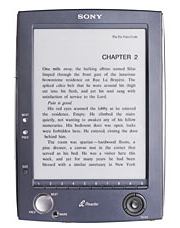
Originally promised for $350 "on or before October 31st," the unit is now hoping to ship in mid-November, but they're on backorder "due to overwhelming demand." Demand for what?? There's precious little content announced for the device. And people are leery about downloading Sony content on their computers (rootkit!) anyway, so, how "overwhelming" can that demand be? Still, according to Engadget, you'll be lucky if you can get your eBook on in time for the holidays. Oh, well, you can always pass the time watching hi-def movies on your Blu-Ray player. Oh, wait. UMD movies then, on your PSP. Oh, wait. Never mind. Better call the whole thing an early-adopter's curse and just wait the extra month for the Panasonic color job. For the same price. With more formats supported. It will make for a much more immersive reading-- and studying!-- experience.
Wednesday, October 04, 2006
OLPC: "Hack Me!"
What do you get when you install millions of mesh-connected computers in markets that are largely under-developed and unprotected? The potential for big-time security problems. Attending the recent TOORCON security conference, OLPC's Ivan Kristi said the project "will create the largest monoculture in history," and invited hackers-- hopefully of the white hat persuasion-- to bang on OLPC's 2B1.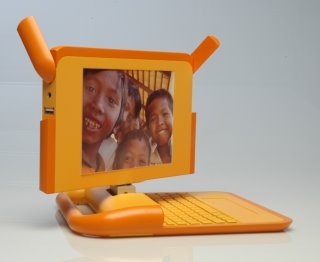
The idea is to get pummeled prior to widespread release, ostensibly so you can patch the holes uncovered in a pre-release assault.
The potential for misuse and abuse is very real, given the 2B1's mesh-connected configuration, which would allow individual units to share applications and OS code ... or malware, if it finds its' way onto a machine.
With orders pending from Nigeria, Brazil, and Southeast Asia, OLPC is naturally and justifiably concerned that the bad guys may be tripping over themselves to exploit the open nature of the 2B1 system. As if we didn't have enough 419 scams from Nigeria already!
Preventive pre-release security tests: definitely Something Cool.
Virtual Tutors Leverage VOIP
The trend of moving traditionally American jobs offshore has now affected education. TutorVista, a young company based in the US, now offers tutoring services and test prep using VOIP and TCP/IP to connect students in the US with English-speaking tutors based in India and Spanish-speakers in Central America.
With rates for basic secondary subject tutoring as low as $20/month for unlimited tutoring, TutorVista dramatically undercuts live-in-person American services that can cost upwards of $50/hour. Preparatory tutoring in advance of MCAT, SAT, GED, and other standardized exams is provided at a higher rate, but nonetheless at steep discounts compared to live domestic services.
Questions for readers of Something Cool: Can offshore tutors supplant services offered by live teachers? Is this "the way of the future" for beyond-school learning? And with the growing number of virtual schools springing up across the country, could we see virtual teachers from India or elsewhere teaching full-on curricula? TutorVista, for its' part, claims that it does not have any "current plans" to supplant live teachers in the US. However, providing virtual instruction to virtual students would seem to be a natural extension of their business model.
So, you tell us: Is this something cool? Or is it merely chilling?
Tuesday, September 26, 2006
Sony's eBook Reader Details
Sure, it's monochrome, with an attention-grabbing 4-scale gray display. But it IS an eBook reader, and while Panasonic may edge this unit (the PRS500) in color displays, the Sony version handles several file formats including rss feeds via built-in wifi, and is priced to move at $350-- the same price point as Panny's color job.
Of course, the "preferred" format for the Sony device is Sony's own BBeB. And we all know how familiar Sony is with Digital Rights Management (DRM) ... remember their rootkit solution on their CDs back in 2005?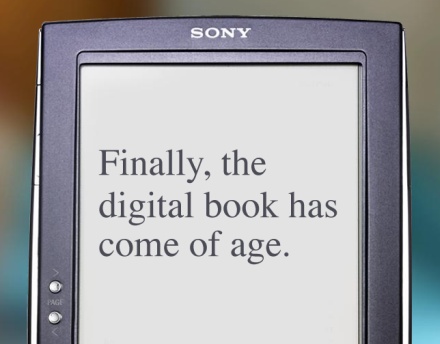
So far, it looks like Panny may have a late-to-the- party -but- better- gadget edge, but until the content wars start and we see what the respective libraries look like, don't expect a particular eBook reader win the adoption wars.
Panasonic Announces Another eBook Reader
OK, it's not like there's a dearth of devices, but it does make some sense that a "playa" in the handheld gadget gearhead garage band would join Sony in the space for an eBook reader.
Panny's device, cleverly named "Words Gear," has a major leg up on the other horses in this race, however-- COLOR! Their display is smallish, measuring about 5.6" diagonally, but it busts a move resolution-wise, sporting a very respectable 1024 x 600 resolution.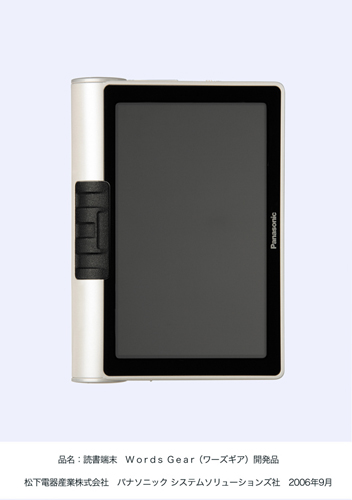
The whole device weighs in at a bestseller-ish .717 pounds, and takes up 4.13" x 1.1" x 6"-- roughly the size of a dog-eared paperback.
The screen, alas, is not touch-sensitive, though there is a touchy-feely area to the left (the, uh, "gutter" side, maybe?) of the screen.
Panasonic promises a Q1 2007 release at a price in the area of $340-- another advantage over the Clio or the Sony monochrome do-dads.
Cool, huh?
Friday, September 22, 2006
Distributed Computing Offers Alternative Path to 1:1 Computing
According to a story posted here by eSchool News-- a story which runs only slightly shy of being a press release-- there's a new alternative to attain 1:1 computing for US schools.
nComputing, a Korean company with operations around the world, has developed a hybrid hardware/software offering that allows the creation of up to 30 "thin client" terminals running from one server or computer. Delivering everything from data to power over cabled connections, the technology allows users to share centralized processing power and RAM, a solution that may take a performance hit on high-overhead applications like gaming, but according to the company, not on more routine school tasks like surfing the interwebs, word processing, e-mail, and basic productivity applications. 
In the nComputing model, a monitor, keyboard, and mouse are hooked up to a small box that is cable-connected to a central computer. The "client" actually has no processor, RAM, or overhead of its' own. According to nComputing, costs for the boxes and software can be as low as $70 per seat, though it's likely that keyboards, monitors, and mice would not be included in that figure.
There was a demonstration of a thin-client setup at NECC; it might even have been nComputing. KSC/LSC actually played with the technology, putting it through some basic paces that might happen in a regular school setting. We surfed a little, ran a few web-based apps like Writely and Google Spreadsheets, picked up e-mail through gmail and Yahoo, and even watched a YouTube video. The video took a few minutes to load, but then played nearly flawlessly (*IF* you can call a YouTube video "flawless"). The concept, and at least the practical demo, seem to make a lot of sense.
nComputing says that most computers and their human users barely scratch the surface of chip/system capability for the most common tasks we use. Their theory is that several users can share those computing resources simultaneously and not take a significant performance hit. The clients don't even have software installed; it's all centralized on the single server or computer that's being shared. This makes for easy maintenance and updates, with lower costs to upgrade when the time comes, according to the company.
Whether or not distributed computing is "the next big thing," it's certainly an option to consider for institutional use, given the growing demand for 1:1 computing capability. Schools in Colorado and Idaho have already adopted nComputing solutions, and the company is counting on word of mouth to spread their success story around the nation and the world. But with the growing availability of web-based applications and productivity tools, it's a safe bet that distributed computing will at least get a second look from schools and organizations with high seat-count demands for low-overhead computing.
Cool, huh?
Friday, September 08, 2006
Philadelphia Opens "School of the Future"
Built for $63 million, Philadelphia's new "School of the Future" is open for business. Developed in partnership between Philly and Micro$oft, the school is physically, pedagogically, and strategically innovative. The building is constructed to be "green," the homework and assessments are online, and the school's robust intranet will serve as a platform for student collaboration, teacher-parent communication, content delivery, and workspace.<br />Publishr2/4468/1072053546620474/1600/SOF_logo.jpg)
Located in West Philadelphia, the school opened to 170 ninth-graders (95% of whom are black, 85% of whom come from low-income families) chosen by lottery from a field of 1500 applicants. There are/were no entrance exams, and the school is tuition-free. The lottery system, according to Philadelphia School District CEO Paul Vallas, means that the "experiment" inherent in cutting-edge education isn't "rigged" by selecting only "the best and the brightest."
Microsoft collaborated heavily with the Philadelphia board of education and school administrators, to develop a robust infrastructure that is designed to minimize paper and to maximize collaboration and information flow. Textbooks are eschewed in favor of interactive content, software, and multimedia assets. (You may recall Microsoft's failed foray into the education space with Microsoft Class Server, a "curriculum manager" that was built as a virtual learning management system.)
Microsoft has gone further with the School of the Future, envisioning a school without walls or limits, where research on the internets is par for the course, and where institutional partners such as the Philadelphia Zoo and the Museum of Art are as integrated with the school as the "food court" that replaces the traditional cafeteria.
Time will tell how well the School of the Future serves today's students, but it's a grand vision and a bold step. Whether it can shed some of the burdens on more traditional schools remains to be seen.
Cool, huh?
Thursday, August 31, 2006
Cellies Get Their Campus Phreak On
The campus grapevine is going high-tech. Move over, word-of-mouth virality, and make room for Rave Wireless, a service being launched on fifteen college campuses this year, and shooting for a hundred schools in 2007.
Rave Wireless is a MVNO (Mobile Voice Network Operator), essentially leasing time from the big-infrastructure wireless companies and then launching their own suite of services, handsets, and plans. (Other examples of MVNOs include ESPN, Disney, and Helio, each with their own "hook.")
Rave is designed specifically for an on-campus college student. The service/handset combination includes several student-friendly features, including the ability to pick up and track classwork assignments from a Learning Management System (LMS), instructor-generated push messaging, and handset access to an online gradebook to check out your GPA, with future plans to allow blogging, social networking, and other savory 3G/Web 2.0 snacks. In addition, the handset includes a GPS (Global Positioning System) chip, and a unique capability that is designed to increase campus safety: a student traveling from point A to point B on campus can set a timer for the duration of their trip. Then, if they don't deactivate the timer or make a call, the GPS unit transmits a "distress" call to campus security, and alerts local authorities that there may be a problem. The campus cops can call the cellie, and if they don't get an answer, can scramble fighter planes or whatever to respond to the phone's location.
There are other campus cell services out there, doing everything from notifying students of their grades to notifying them when a dryer is free in the laundry room. But Rave Wireless seems to have the richest set of offerings to date. Sheesh-- add music downloads to the handset on some kind of subscription service like Yahoo or Napster and this thing would probably be close to perfect.
The article, here, on USA Today doesn't mention monthly service fees, but one can imagine that these services carry some kind of premium. But if Mumsy and Daddums are footing the bill anyway ... . Of course, most student phones are adjuncts to some kind of family plan, so Rave, for the moment, probably means students would have to carry two handsets-- one for talking and texting, and another for all the other 3G goodness. But it's not hard to imagine services like these finding their way to the major carriers in the not-too-distant future. Converged data and communication, after all, is the name of the game. And as mentioned above, if a clever carrier adds content, the "Three Cs" will be covered and enrollment would seem to be a slam-dunk.
Cool, huh?
Monday, August 28, 2006
Dramatic MySpace Vulnerability Exposed, Closed
Members or readers of social network site digg.com are today engaging in some self-congratulation. Seems the "digg effect" was in play Sunday, whereby a digg user posted a blog post about a major security hole in MySpace. Turns out, all you had to do was append a few letters to the end of a "private" MySpace url and you could see everything that was intended to be password-protected. In other words, "private" was really public, with the simplest of hacks. Literally all you had to do was enter a few characters at the end of the url in your browser; this is something anyone could have done, and probably "anyone" was doing it.
Apparently the vulnerability was originally discovered in April of 2006, and was-- allegedly-- brought to the attention of MySpace administrators. But it took something of a wake-up call to get the MySpace techies mobilized, it seems. After months of inaction, someone posted the details of the vulnerability on digg, where the story received thousands of diggs (votes) and which doubtless generated hundreds of hits to MySpace to try the hack. The story appeared on digg on August 27.
By the following day, the vulnerability had been plugged, at least temporarily, by an abashed MySpace. Digg users, naturally, claim credit for bringing focus to the issue and forcing MySpace to do something about it. There isn't an obvious mention of the issue on the front pages of myspace; it's unclear whether there's any way to tell if a user's "private" content was viewed by someone using the exploit.
This is yet another example of the potential "dangers" of online social networks, but it's also a great example of how another social network (digg) was able to rally their user base and create a positive outcome. While it's scary that lots of private data may have been compromised, it's also good to know that there are enough "good guys" out there to rally around an issue that needs attention, and bring about a resolution (however belated). Let's hope the diggers and other networks like them keep a weather eye open for John Q Public. And for heaven's sake, PLEASE be smart about what you post to your online presence-- even private stuff is likely to be viewed by people you don't know. Be smart, and don't post anything online that you wouldn't put on a billboard along a major highway.
digg this post
Friday, August 25, 2006
Want to learn something cool?
Well, who doesn't, right? This blog post is a trial run in the new Blogger beta, and may eventually become the home of the well-traveled "Want to know something cool?" that lives over on the "old" Blogger boxes. Whether we merge, migrate, or just start running in parallel with slightly different bents on things educational, technological, and, well, cool, we'll keep both urls open so that we can minimize confuzzlement and (hopefully) drive more traffic.
Meanwhile, we'll play around with Blogger Beta's new features, including the labels that may have brought you here. Sorry for the detour, but if you're looking for things that actually go along with the labels on this post, please jump over to our older sister blog, "Want to know something cool?" where you'll find lots of posts on technology and its' impact on education. Thanks for visiting; we hope you'll dig WTKSC and eventually, when we get up and running, you'll come back to learnsomethingcool as well.
Subscribe to:
Posts (Atom)

